Additional charges
A charge a guest cannot see the reason for is a bad review with arithmetic attached. Every line here carries its name and its rule.
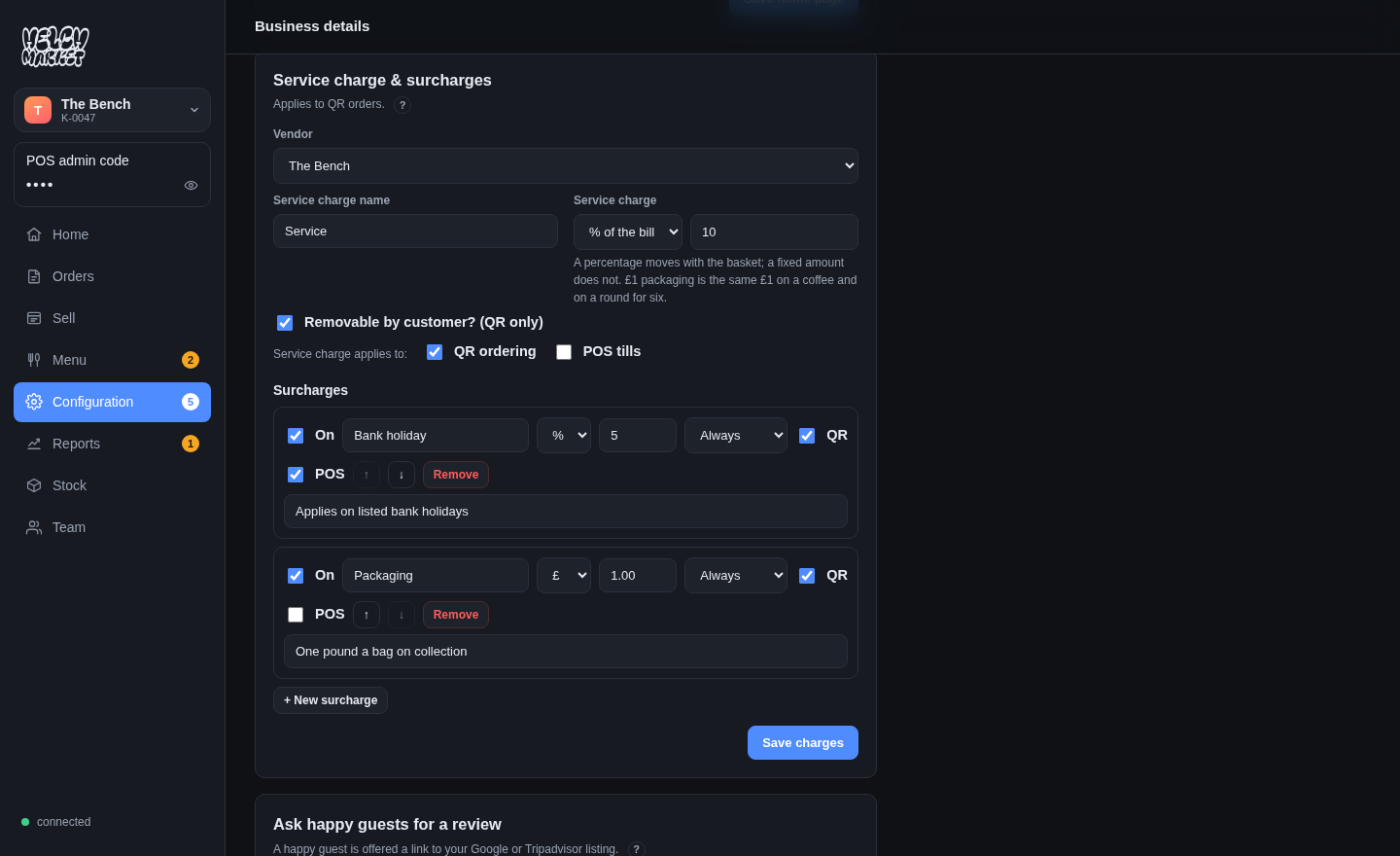
Real screenshots of the running product — the same screens you get, showing real data, not mock-ups.
What it does
A venue can add a service charge and a surcharge on top of the food: each is either a percentage or a fixed amount, and a fixed one carries whatever name you give it — a bank-holiday charge, a charity donation, a late-night line. Each charge applies per channel — on the QR menu, at the till, or both — and can run on a schedule, so a weekend surcharge starts and stops on its own.
The guest is told, not surprised
The checkout itemises every charge under its own name with an explainer of how it was worked out, rather than folding them into one number. And a service charge you mark as optional really is: the guest gets a remove control at the QR checkout, and the order is priced again without it. A discretionary charge with no way to decline it is not discretionary.
One surcharge at a time
If several surcharges could apply at once — a scheduled one and a standing one — exactly one is chosen, deterministically, rather than stacking. A guest never pays two surcharges because two rules happened to overlap.
Where the money lands
Charges are carried on the order in their own columns — never inside the food price — so VAT is worked out on the goods and reports split food from charges. A line refund returns the dish and its VAT; the charge on the order comes back through an amount refund, when you choose to, rather than by guess. A food hall can also set a customer processing fee that is the hall’s own revenue line, kept by the hall rather than split to the kitchens.
What it refuses
A charge that does not say whether it is a percentage or an amount, a percentage over 100, or an amount with no name are all refused at the point of setting them up, in words — not silently accepted and wrongly billed later.
Free to use.
Every feature on this site is in the product now. The ones that are not built are named on the comparison page rather than left out.